Shut every window in a 1920s Buffalo double and the house keeps breathing anyway. It draws air up from the basement, through hollow walls and out the attic, and that air carries soil gas, old paint dust and moisture you’ll never see.
Checking air quality in Buffalo, NY usually means a glance at the outdoor reading. But your family breathes indoor air most of the year, and in an older home that air follows its own rules. Buffalo’s housing ranks among the oldest of any large U.S. city, so nearly every block has houses like this. Here’s how I’d work through one, basement to attic, starting with the fixes that protect your family most.
TL;DR Quick Answers
air quality Buffalo NY
Buffalo’s outdoor air usually rates Good or Moderate on the AQI, though summer ozone and Canadian wildfire smoke can push readings past 100. Your family breathes indoor air far more of the year, though, and in the city’s older homes the stack effect pulls radon, lead dust and basement moisture upstairs all winter.
Under 50 (Good): Open windows and air the house out.
Above 100: Keep the house closed. Set the HVAC fan to On with the best filter your system handles, or run a portable HEPA cleaner in radiator homes.
Test for radon: Erie County is a state-designated high radon area, so test even if you live inside city limits.
Seal the attic floor: Closing those gaps slows the draft that carries basement air to every floor.
Top Takeaways
Your floors share air. Older homes pull basement air up and out through the attic all winter.
Seal, then insulate. Closing attic floor leaks slows the draft that carries soil gas and dust upstairs.
Leave vermiculite alone. EPA says to assume it contains asbestos. Leave removal to a certified pro.
Test for radon. Erie County is a high radon area, and the surrounding towns run far higher than the city.
Keep lead dust and humidity in check. Wet cleaning, HEPA vacuums and 30 to 50 percent humidity protect your family.
Why Older Buffalo Homes Hold Onto Indoor Pollution
Pre-war houses leak in predictable places. Through every heating season, warm air rises and slips out through gaps in the attic floor. Something has to replace it, so the house pulls air in low, through basement walls, sill plates and cracks in the floor. Building scientists call this the stack effect. A Western New York winter keeps it running for months.
Balloon framing, open chimney chases and old plumbing runs give that rising air a clear route to every floor, so whatever sits in the basement or attic reaches your living room sooner or later. Indoor air quality testing helps identify pollutants that may spread through these hidden pathways and affect the air you breathe.
Check Air Quality in Buffalo, NY Before You Open the Windows
Opening windows flushes indoor pollutants out, as long as the outdoor air is cleaner. The Air Quality Index (AQI) boils outdoor pollution down to one number between 0 and 500, and lower is better. Check today’s air quality in Buffalo NY before you air out the house. On hot afternoons when ozone builds, or when wildfire smoke drifts down from Canada, keep everything shut. On a clean day, a short cross-breeze clears out stale air and cooking fumes.
Seal the Attic Floor Before You Add Insulation
Most people file the attic under energy bills. For your indoor air, though, the attic is the exit, and it’s where the stack effect gets its pull. ENERGY STAR names the usual leak points: the attic hatch, wiring and plumbing holes, recessed lights, dropped soffits, kneewalls and the gap around the furnace flue.
Seal those openings first, then add insulation. Closing the gaps slows the upward draft, so less soil gas and dust rises from below. Insulation by itself won’t stop moving air. Dark, dirty patches on old insulation usually mark where air has been pushing through.
Pre-war attics come with two extra cautions. Knob-and-tube wiring, common before 1930, needs an electrician’s review before anyone insulates around it. And if your insulation has been up there for decades, read up on whether old insulation needs upgrading and when to remove old attic insulation before adding new.
If You Find Vermiculite, Leave It Alone
Vermiculite looks like pebbly, gray-brown or gold loose fill, and installers poured it into plenty of attics through the 1980s. Much of it came from a Libby, Montana, mine whose ore carried asbestos. EPA tells homeowners to assume it contains asbestos and leave it undisturbed.
Keep attic trips rare and brief, and store nothing up there.
Keep children out of the attic entirely.
Caulk ceiling gaps around light fixtures from below so particles can’t sift into your rooms.
Bring in an accredited asbestos abatement contractor before any project that would disturb it.
Test for Radon, Even Inside City Limits
Radon has no color and no smell. This radioactive gas seeps from soil into basements, and the stack effect helps carry it upstairs. New York State lists Erie County as a high radon area, though the risk shifts a lot from town to town.
When I looked at the state’s town-by-town estimates, about 3 percent of Buffalo city basements tested above the 4 pCi/L action level. In Aurora and Boston, roughly half did. Concord came in at 65 percent. Living inside city limits lowers your odds without erasing them, and only a test tells you where your home stands. Short-term kits don’t cost much, and if yours comes back high, a certified mitigator can install a reduction system.
Keep Lead Dust Out of the Air You Breathe
The federal government banned lead paint in homes in 1978, and most Buffalo houses are decades older than that. Every time a window sash slides or a door swings, old paint grinds into fine dust. That dust settles right where kids crawl and play. High quality filters help capture airborne particles, but lead dust on surfaces still requires careful cleaning and proper lead-safe remediation.
Wet-wipe window sills and floors weekly instead of dry dusting.
Vacuum with a HEPA-filtered machine so fine dust doesn’t blow back into the room.
Keep painted surfaces intact and patch peeling spots promptly.
Hire an EPA RRP-certified contractor for any renovation that disturbs old paint. Erie County’s LeadSAFE program offers free classes and repair help for qualifying homes.
Control Winter Dryness and Basement Dampness
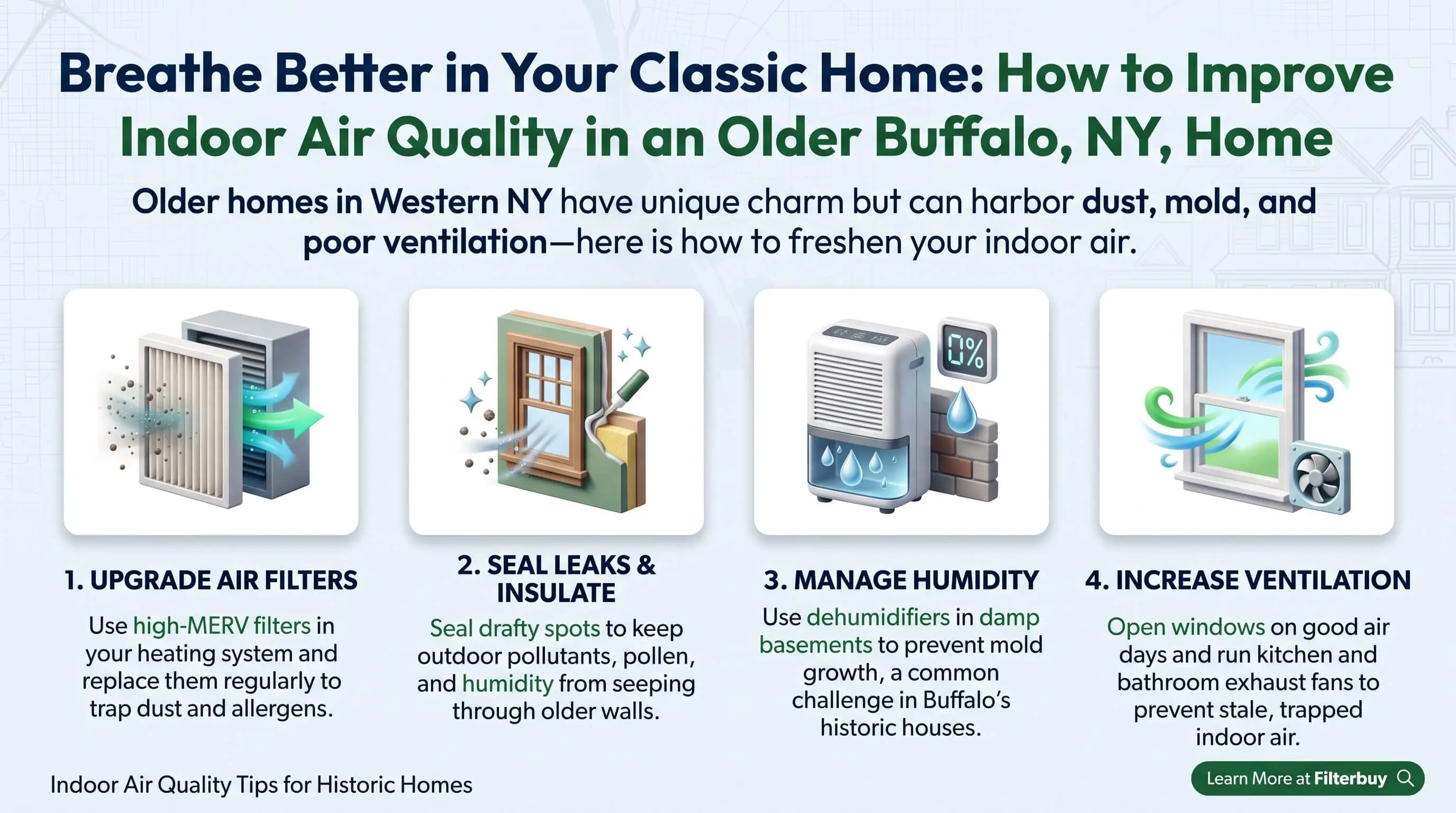
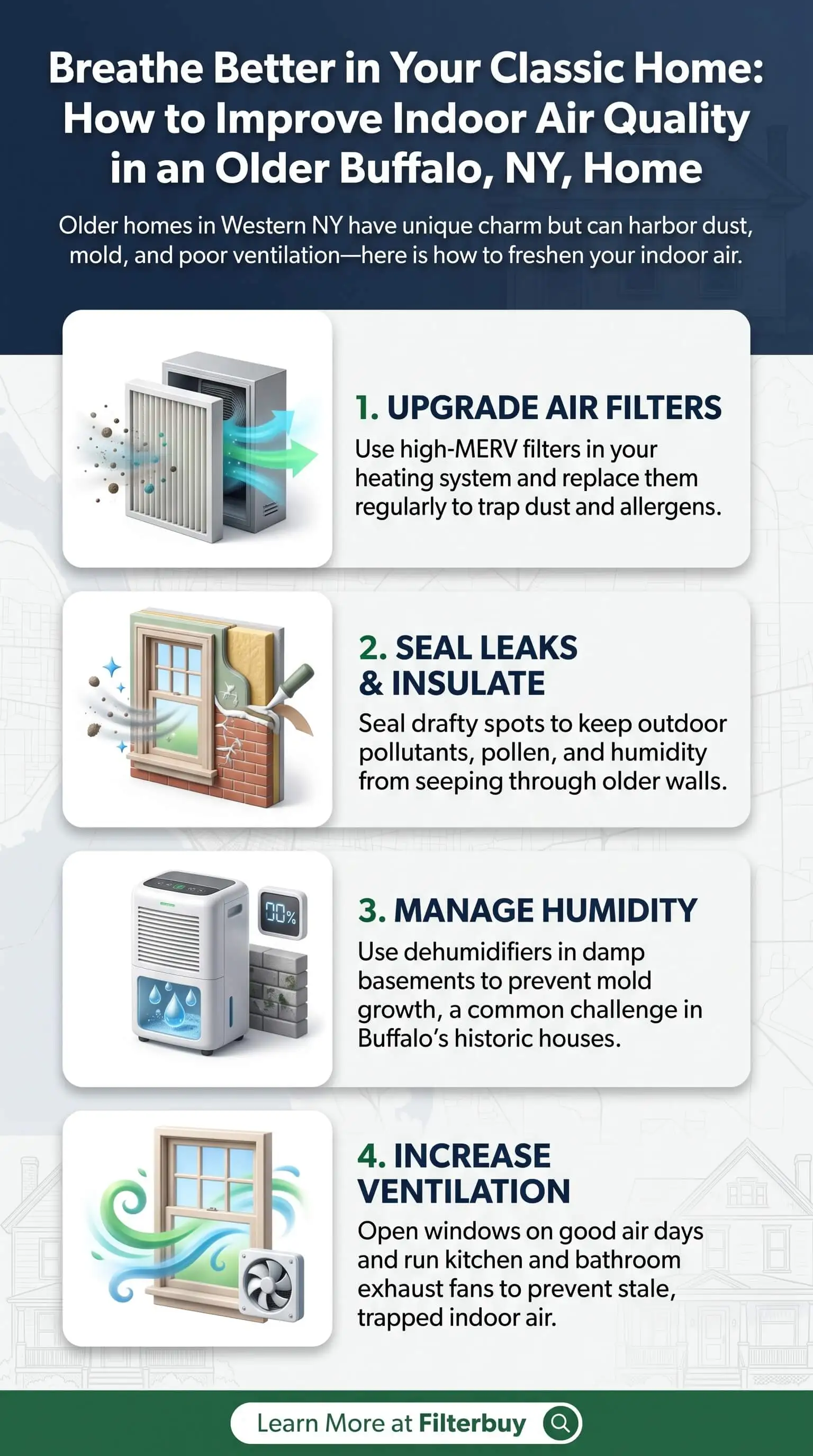
Buffalo homes fight humidity on two fronts. In winter, condensation beads up on single-pane windows, a sign moisture is collecting where mold can start. Summer leaves stone and block basements cool and damp. EPA recommends keeping indoor relative humidity between 30 and 50 percent. An inexpensive hygrometer shows you where you stand. Run a basement dehumidifier through the muggy months, check that bath fans vent outdoors and fix any gutters dumping water against the foundation.
Vent Gas Stoves, Furnaces and Water Heaters
Plenty of older Buffalo homes still cook and heat with gas. Turn on a range hood that vents outdoors every time you use a gas stove. Before the heating season, have a technician inspect the furnace or boiler, the chimney liner and the water heater flue, since cracked or clogged masonry chimneys can push exhaust back inside. Carbon monoxide alarms belong on every level and outside sleeping areas. Test them once a month.
Filter the Air: Forced-Air Homes vs. Radiator Homes
Your heating system decides how you filter. In a forced-air home, use the highest MERV rating your system can handle, change it on schedule and set the thermostat fan to On during smoky or high-pollen stretches.
Boiler and radiator homes don’t have ducts or a central filter. There, a portable HEPA cleaner sized to the room does the heavy lifting, and bedrooms come first. MERV 8 pleated furnace air filters are designed for compatible forced-air heating systems, making them unsuitable for boiler and radiator setups without ductwork. Skip ionizers and ozone generators, which can add pollutants to the air you’re trying to clean.
“In the pre-war houses I test across Western New York, the basement and the attic are connected by air you can’t see. When the attic floor gets sealed first, I routinely watch upstairs humidity and radon readings drop before anyone has touched a filter.”
Essential Resources
Protect Your Family From Radon: A Guide for New York State Residents (New York State Department of Health). High-risk counties, test kits and certified mitigators.
Protect Your Family from Asbestos-Contaminated Vermiculite Insulation (U.S. EPA). How to spot vermiculite and what to do next.
Attic Air Sealing Project (ENERGY STAR). Where attic leaks hide.
Lead Poisoning Prevention (Erie County Department of Health). LeadSAFE repair help and homeowner classes.
Using the Air Quality Index (AirNow). What each AQI category means.
Air Quality Index Forecast and Current Observations (NYS DEC). Daily forecasts for Western New York.
Lead Hazards and Lead Poisoning Prevention (City of Buffalo). Lead sources in older homes and local rules.
Supporting Statistics
Radon odds climb sharply outside the city.
About 3 percent of Buffalo city basements tested above 4 pCi/L, compared with 12 percent countywide and 65 percent in the Town of Concord.
Source: NYSDOH Wadsworth Center, Erie County Indoor Radon Estimates (2007)
Buffalo has fought lead poisoning for decades.
Buffalo has ranked among the nation’s worst cities for childhood lead poisoning since at least the early 1990s, and Erie County has named nine city ZIP codes communities of concern.
Carbon monoxide peaks in the heating season, at home.
Unintentional carbon monoxide poisoning not linked to fires kills nearly 500 Americans a year. More than half of exposures happen between November and February, and 77.6 percent happen in a residence.
Final Thoughts and Opinion
Owners of older homes tend to reach for the visible fixes first, like a new filter or an air purifier, and skip the hidden problems that matter more. A century-old Buffalo house can be a genuinely healthy home once you know what’s moving through it. So test for radon. Check the attic before anyone disturbs it, seal the attic floor and keep lead dust under control. Save filtration for last, when it has far less work to do.
Frequently Asked Questions
What Is the Air Quality in Buffalo, NY Today?
A live AQI map or AirNow shows the current reading, and DEC posts a daily Western New York forecast. Under 50 is good. Above 100, children, older adults and anyone with asthma or heart disease should limit time outdoors, and everyone should keep windows closed.
Is Radon a Problem in Buffalo Homes?
It can be. Erie County is a state-designated high radon area. City basements test lower than surrounding towns, about 3 percent above the action level, but any home can run high, and only a test will tell you.
Is Old Attic Insulation Bad for Indoor Air?
Old fiberglass or cellulose rarely causes harm by itself. The bigger issue is a leaky attic floor that lets air and dust move freely. Vermiculite is the exception, so assume it contains asbestos, leave it in place and let a certified contractor handle removal.
How Do I Clean the Air in a House With Radiators?
Without ducts, a radiator home has no central filter. Run a portable HEPA cleaner sized to each occupied room, bedrooms first, alongside radon testing, lead-safe cleaning and a vented range hood.
How Often Should I Test Indoor Air in an Older Home?
Retest for radon every two years and after major renovation or foundation work. Check humidity each season, and test carbon monoxide alarms monthly.
Breathe Easier in Your Older Buffalo Home
Start with a radon test and a close look at your attic floor, then work through the house one source at a time. For homes with pets, learning how to get rid of pet dander through regular cleaning and proper air filtration helps reduce allergens circulating indoors. Your home has sheltered Buffalo families for generations, and a few targeted fixes can make the air inside it just as dependable.


