TL;DR Quick Answers
top insulation installation near Clermont FL
For Clermont homes, top insulation installation near Clermont FL means R-49 blown-in fiberglass or open-cell spray foam, properly air-sealed to Florida Climate Zone 2 standards (minimum R-38). Most homes here built before 2010 sit below code today. The job starts with measuring what the attic actually does before we order new material.
Florida Building Code minimum: R-38 attic insulation for Climate Zone 2
What we recommend in Clermont: R-49 as the practical sweet spot for most single-family homes
Typical install timeline: 6 to 8 hours for blown-in, 1 to 2 days for spray foam
Signs your attic is short: visible ceiling joists, hot upstairs rooms, longer AC cycles, climbing summer bills
Top Takeaways
Florida Building Code Climate Zone 2 requires R-38 attic insulation at minimum. Most Clermont homes built before 2010 are below that today.
Florida humidity makes loose-fill insulation settle and lose effective R-value over the years. What the original bag rated is rarely what the attic actually performs at now.
Blown-in fiberglass and open-cell spray foam are our two go-to choices for most Central Florida attics. Closed-cell spray foam is the premium option when ceiling depth is limited.
Installation quality matters as much as the rated R-value. Gaps, compression around can lights, and unsealed ceiling penetrations can erase the performance gain of any product.
Verify any insulation contractor through the Florida DBPR license lookup at MyFloridaLicense.com before signing a contract.
Why Clermont Attics Run Hotter Than Most
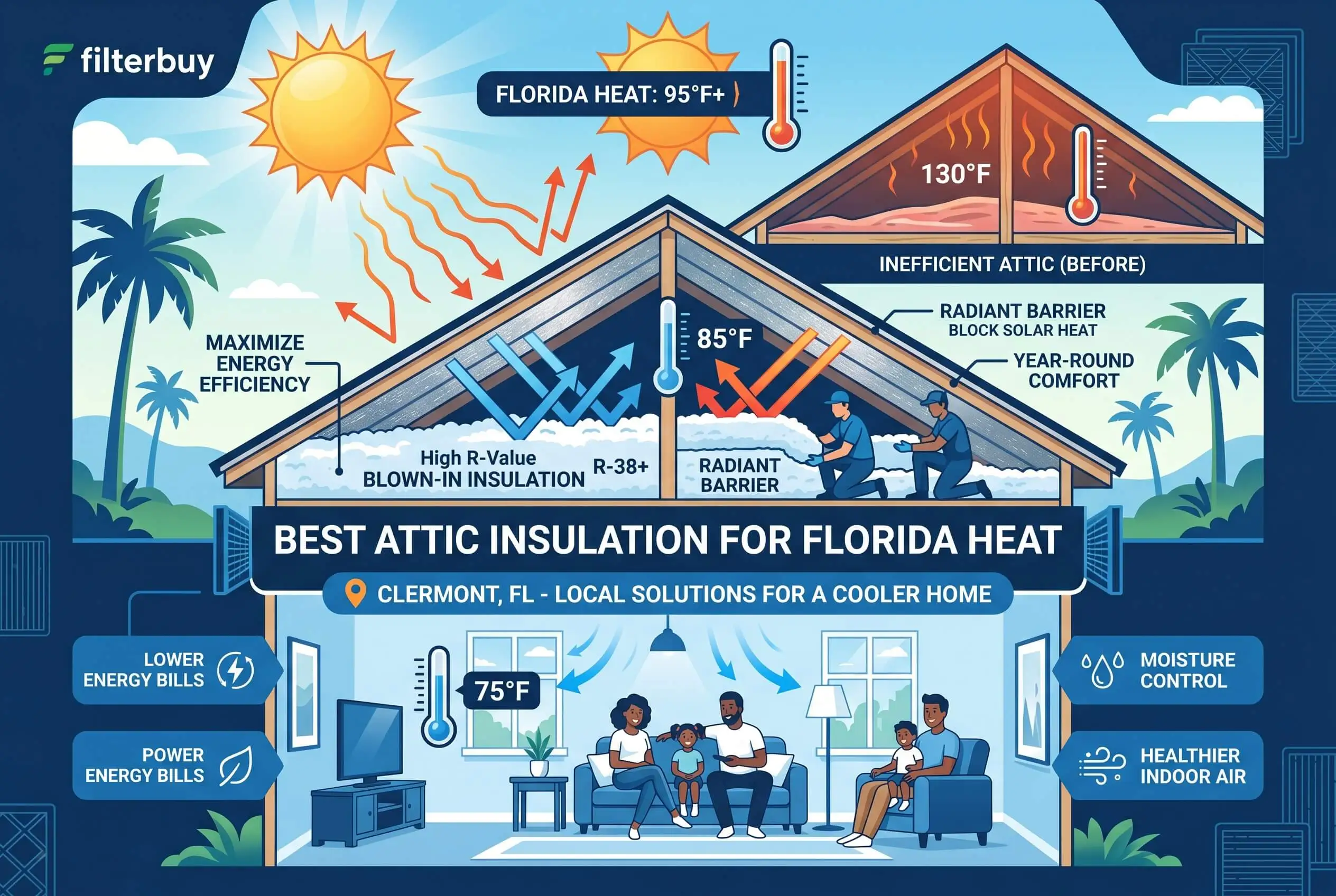
Florida puts Clermont in IECC Climate Zone 2A, which is just code shorthand for hot and humid year-round. We've measured plenty of Clermont attics at 130 to 140°F in mid-July, and a few that pushed past 150°F under dark architectural shingles with weak soffit ventilation. The rolling hills along the Lake Wales Ridge that give Clermont its postcard view do nothing to shade the roof. The citrus groves that once did are long gone.
That fifty to sixty degree gap between attic air and living space is why insulation matters more here than in almost any other part of the country. With the wrong R-value, your ceiling turns into a heat radiator from late morning until well after sunset, and the AC pays the price all afternoon. Walls and windows matter too, and so does the slab, but none of those surfaces faces the daily thermal load that the attic floor does. Most Clermont homes also run ducted HVAC through that same superheated space, which compounds the problem before cool air ever reaches the room — one of the biggest reasons homeowners invest in a professional attic insulation installation service to improve overall efficiency and comfort.
What R-Value Your Clermont Home Actually Needs
R-value tracks how well an insulation material resists heat flow, and a higher number means better resistance. Florida sets its insulation requirements through the Florida Building Code, which splits the state into two climate zones. Clermont sits in Zone 2 along with most of Central and North Florida, and Zone 2 calls for a minimum of R-38 in the attic.
That R-38 is the legal floor to certify new construction or an addition. The U.S. Department of Energy and ENERGY STAR both recommend going higher than the code floor, somewhere in the R-38 to R-60 range, for southern climates where cooling drives the bill year-round. For most single-family Clermont homes, we've found R-49 hits the practical sweet spot between cost and performance. That works out to roughly 14 to 16 inches of properly installed blown-in fiberglass.
The R-value most Clermont homes actually have, though, is a different story. When we walk attics in homes from the late-90s ZIP 34711 wave, we routinely find original R-19 or R-22 batt insulation that has been settling in Florida humidity for two and a half decades. The bag said R-22 in 1998. The attic is performing closer to R-13 today.
Comparing the Four Insulation Types We Install in Clermont
Four insulation products cover most of what we install in Clermont attics. The right choice for any given home depends on what is already up there, what the ceiling depth allows, and what the homeowner wants to spend.
Blown-in fiberglass is the workhorse. It runs about R-2.2 to R-2.7 per inch, installs in a single afternoon, and works well as a top-up over existing batts. Florida humidity does cause it to settle over time, so we install to a target depth instead of relying on a target bag count.
Blown-in cellulose gives you more R-value per inch, at roughly R-3.2 to R-3.8, and it's made from recycled material with decent sound dampening. The catch in our climate is moisture. When cellulose absorbs humidity past about 20 percent moisture content, its R-value drops measurably until the attic dries out, and inland Florida attics don't always dry out fast.
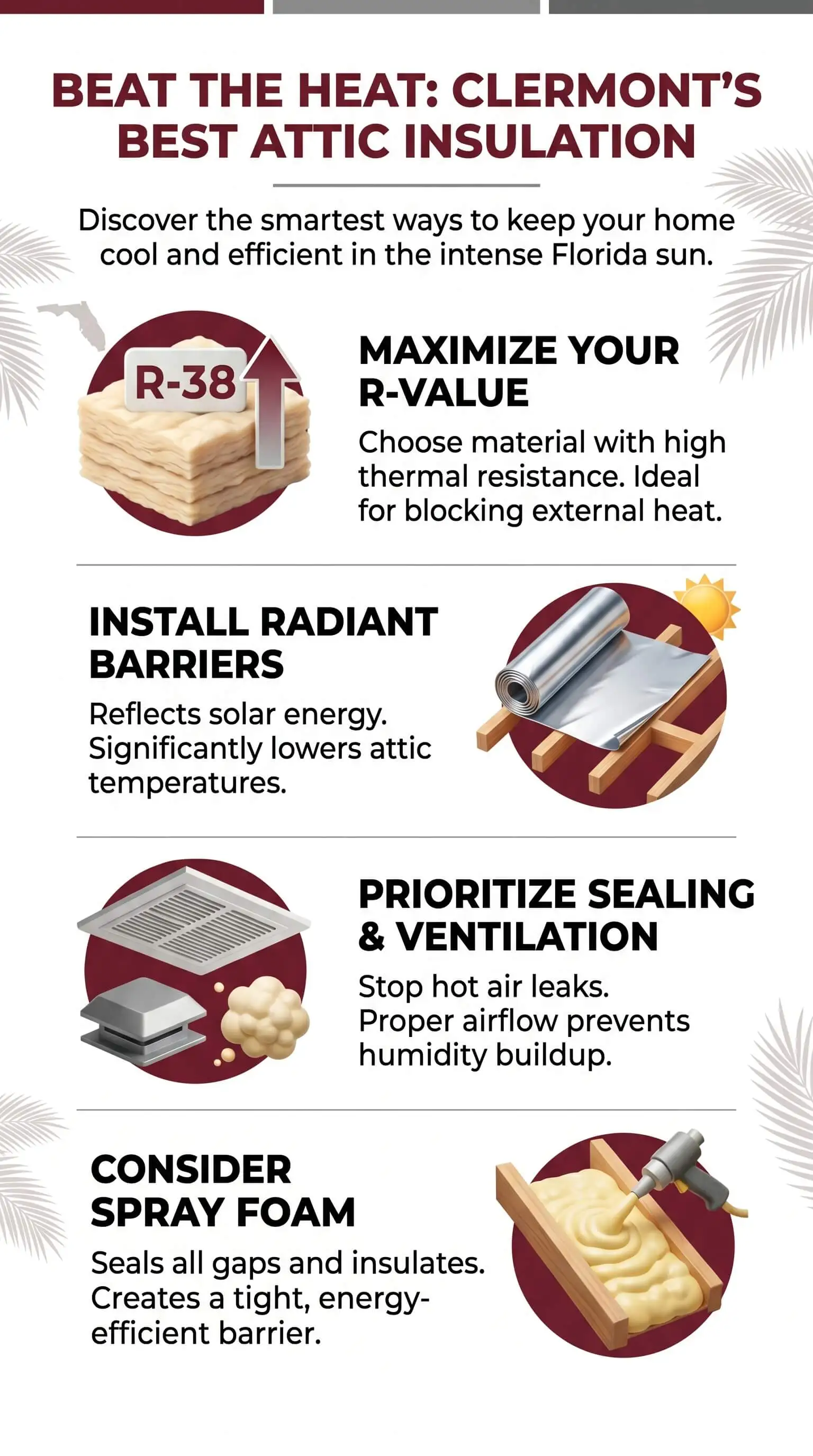
Open-cell spray foam runs about R-3.5 per inch and air-seals as it expands, which makes it our go-to for unvented attic conversions where you're moving the thermal envelope from the attic floor up to the roof deck. That's a bigger project. It changes the way the whole house performs.
Closed-cell spray foam is the premium option at R-6 to R-7 per inch, and it doubles as a moisture barrier. We tend to specify it when ceiling depth is limited or when a homeowner wants the maximum R-value per inch installed.
Signs Your Current Attic Insulation Is Falling Short
Most Clermont homeowners discover the attic insulation problem on the electric bill before they ever discover it visually. A few things give it away first when we do climb up there.
Visible joists from the access hatch are the most immediate tell. Standard 2x10 joists run 9.25 inches deep, so if you can see the top edge of a joist crossing the attic floor, you're below R-19, which already puts you well under the Zone 2 code minimum.
Upstairs rooms running five to ten degrees warmer than downstairs by late afternoon is another reliable signal. So is a Duke Energy bill that climbed noticeably year over year without any new appliances or new people in the house. AC cycles that run 25 to 40 minutes long in mid-summer without ever reaching the thermostat setpoint usually point to either an AC sizing problem or attic heat gain, and attic heat gain is by far the cheaper one to address.
The other thing we look for is compressed or matted insulation around can lights, bath fans, and HVAC platforms. Even if the rest of the attic shows good depth, those compressed zones lose their rated R-value at exactly the spot it matters most. We air-seal those penetrations before laying down any new material on almost every Clermont service call we run.
How Our Installation Process Works in a Typical Clermont Home
A standard blown-in installation in a 2,000 to 2,500 square foot Clermont home takes us about six to eight hours from arrival to cleanup. We start with an inspection. We document moisture, pest activity, existing insulation type and depth, ventilation balance, and any visible duct or electrical issues before we cover anything up.
Air sealing comes next. We seal every penetration that comes through the ceiling plane, including recessed lights, plumbing stacks, top plates, electrical boxes, and HVAC chases. We use fire-rated foam or caulk depending on what the penetration calls for. Insulation without air sealing is like putting a winter coat over a screen door, and plenty of Clermont homes we walk into have insulation that a previous contractor laid down exactly that way.
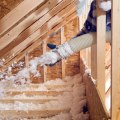
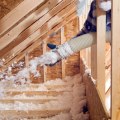
Then we blow in the new material to the target depth, with a depth ruler we install at each end of the attic so you can verify R-value at any point in the future. We finish with a walk-through, photos of the depth markers at both ends, and a written summary of what we installed and where. For homeowners who want to understand the broader physics of why insulation matters at all, the overview of building insulation maintained at Wikipedia is a solid independent reference that goes further than what we can fit on a single estimate.
Essential Resources
These are the primary references we point Clermont homeowners to when they want to verify code requirements, understand R-value choices, or check that a contractor is properly licensed in Florida. Every link below was verified live during page production.
1. U.S. Department of Energy: Insulation. The federal reference page on R-value recommendations, climate zone maps, and what insulation is actually doing inside the wall and ceiling cavities of your home.
2. ENERGY STAR: Recommended Home Insulation R-Values. Recommended R-value tables organized by climate zone and by area of the home (attic, walls, floors), published by the EPA-administered ENERGY STAR program.
3. ENERGY STAR: Rule Your Attic Campaign. A homeowner-facing guide to inspecting your attic insulation and spotting where air sealing is needed before any contractor walks the property.
4. Florida DBPR: Verify a License. The official Florida Department of Business and Professional Regulation contractor lookup. We tell every Clermont homeowner to run their contractor through this before signing anything.
5. Florida Building Commission: Florida Building Code. The state code authority. The Energy Conservation volume sets the R-38 attic minimum for Climate Zone 2 that applies to Clermont and the rest of Lake County.
6. Oak Ridge National Laboratory: Insulation Fact Sheet. A federal research lab walkthrough of insulation materials, R-values, and the installation factors that affect how each one actually performs in a real home.
7. U.S. EPA: State and Local Energy Efficiency Programs. The federal resource hub for state-level energy efficiency programs and rebate directories, which is where Florida-specific incentive details show up first.
Supporting Statistics
Three primary-source statistics worth knowing if you're weighing an attic insulation project in Clermont. Each one points to a federal data agency through the link provided.
1. Air sealing and insulation are among the highest-return home energy improvements.
The U.S. Department of Energy positions air sealing combined with attic insulation upgrades among the most cost-effective home energy improvements available to homeowners, particularly in cooling-dominated climates like Central Florida. Source: U.S. Department of Energy: Air Sealing Your Home.
2. Clermont's housing stock has more than tripled since 2000.
U.S. Census Bureau data shows Clermont's total housing units have more than tripled since 2000, with the bulk of single-family homes built between 2000 and 2019. That building era covers the homes now reaching the 15 to 25 year mark, where original attic insulation typically performs well below current Florida Building Code requirements. Source: U.S. Census Bureau QuickFacts: Clermont city, Florida.
3. Florida households carry one of the highest cooling loads in the country.
The U.S. Energy Information Administration's Residential Energy Consumption Survey shows households in the South Atlantic census region (which includes Florida) carry a higher share of annual electricity consumption tied to cooling than households in any other U.S. region. That single fact makes the attic floor an outsized lever for Clermont homeowners. Source: U.S. Energy Information Administration: Residential Energy Consumption Survey.
Federal housing and energy data consistently reinforce why working with a qualified insulation installation company matters in Clermont, especially as older homes face rising cooling demands, aging attic insulation, and the heavy year-round thermal load common across Central Florida.
Final Thoughts
Most attic insulation conversations in Clermont turn into a referendum on R-value, and that's the wrong place to start. The bigger question is what the existing attic is doing today versus what the home needs to actually perform through a Zone 2 summer. We've seen homes where the R-value on paper looked fine but air leakage at the ceiling plane was doing 60 percent of the damage. In other cases, a previous contractor blew a thick new layer over old, settled batts and never addressed the underlying problem at all.
After walking attics from the older Greater Hills neighborhoods down to Wellness Way and along the U.S. 27 corridor, our honest opinion is that the right insulation project leads with measurement and air sealing. New material comes after that groundwork is finished, because the importance оf attіс insulation only becomes fully clear when the entire system is evaluated together.
Frequently Asked Questions
What R-value does my Clermont attic actually need?
Florida Building Code sets the minimum at R-38 for Climate Zone 2, which covers Clermont and most of Central Florida. The U.S. Department of Energy and ENERGY STAR both recommend going higher, up to R-49 or R-60, for our climate. For most single-family Clermont homes, we target R-49 as the practical sweet spot between cost and cooling performance.
How much does attic insulation cost in Clermont FL?
Costs vary by attic size, the condition of any existing insulation, and the material you choose. A typical 2,000 to 2,500 square foot home falls in the range of $[VERIFY] to $[VERIFY] for blown-in fiberglass installations, with spray foam projects running higher. We give you a written estimate after the attic inspection so you can see exactly what's going where and why.
How long does an attic insulation installation take?
A standard blown-in install in a single-family home takes us about six to eight hours from arrival to cleanup. Spray foam projects can take a full day or two depending on the area covered and the cure time required before anyone reoccupies the space.
Should I remove old insulation or install new material over it?
That depends on what's up there. Existing insulation that's dry, free of pests, mold, and major contamination can usually be topped off with new material. Insulation that's wet, rodent-soiled, fire-damaged, or older and containing vermiculite has to come out first. We make that call during the pre-install inspection and we document our reasoning in writing.
Do utility rebates apply for attic insulation in Lake County?
Duke Energy Florida runs home energy programs that sometimes include rebates or incentives for insulation and air sealing improvements, and the specific programs change year to year. We check the current program list at the time of your estimate and we let you know what your address qualifies for before any contract gets signed.
How do I verify my insulation contractor is licensed in Florida?
Go to MyFloridaLicense.com, which is the Florida Department of Business and Professional Regulation's contractor lookup. Search by company name or license number and confirm the license is active and in good standing. It's one of the simplest trust checks a Clermont homeowner can run before signing anything.
We Measure What Your Attic Is Actually Doing, Seal Every Air-Leak Point, and Put a Written Estimate in Your Hand Before Any Material Gets Ordered. Reach Out for a Clermont Attic Assessment Built for the Florida Heat You're Living In.
Proper insulation is only part of keeping a Florida home energy efficient. As explained in 16x25x2 furnace air filters, attic heat places constant strain on HVAC systems, especially during long summer afternoons when cooling demand peaks. That makes airflow maintenance equally important, which is why many homeowners pair upgraded insulation with high-quality HVAC filters like these MERV 8 pleated HVAC filters and Filterbuy AC furnace filters. Cleaner filters help reduce system strain, improve indoor air quality, and support the overall efficiency gains that proper attic insulation is designed to deliver in hot Clermont climates.